

Zero Trust Security for Modern Enterprises
Key Principles & Challenges
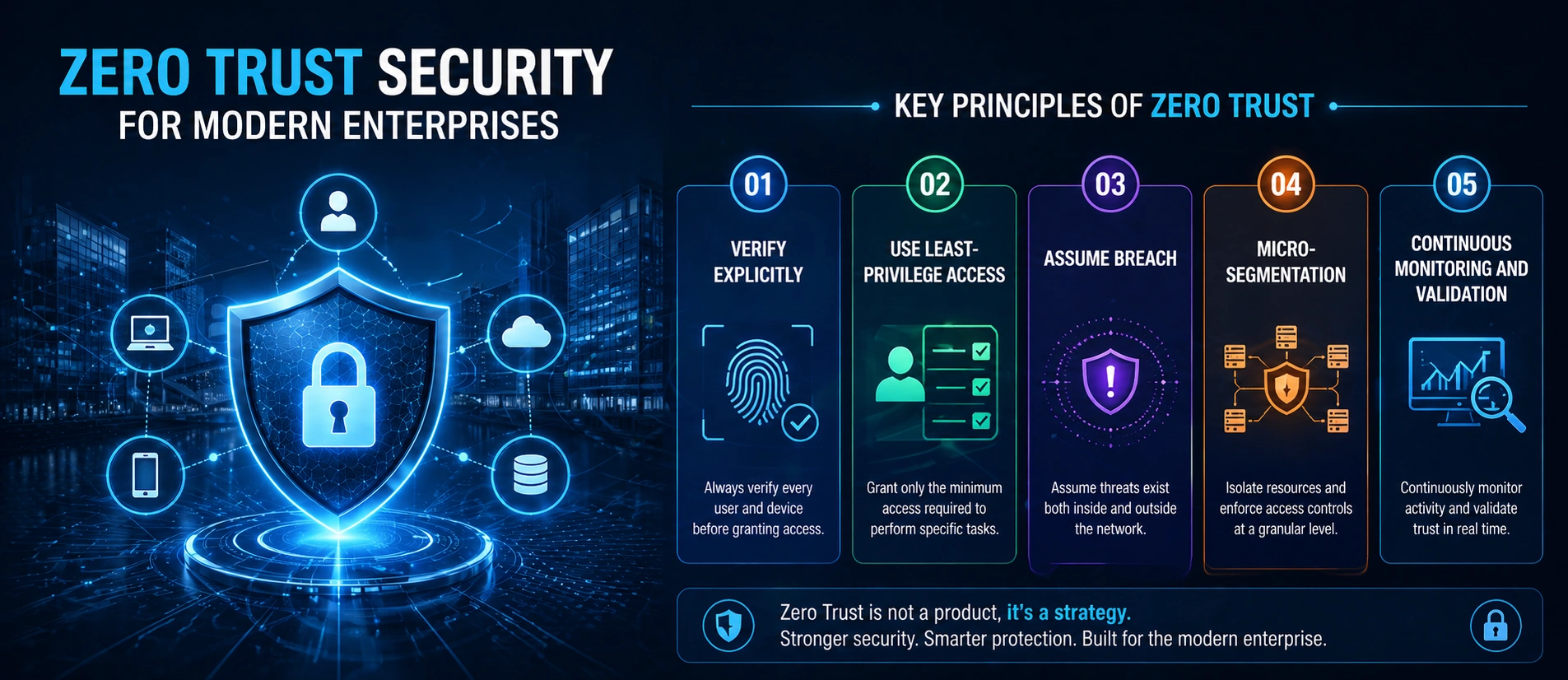
The modern enterprise operates in a radically different environment than it did a decade ago. Remote workforces, multi-cloud ecosystems, and a rapidly expanding attack surface have rendered the traditional 'castle-and-moat' approach to security obsolete. Enter Zero Trust Security - a framework built on a deceptively simple premise: never trust, always verify.
Zero Trust is not merely a product or a checklist. It is a strategic security philosophy that challenges the assumption of implicit trust within any network. Whether a request originates from inside or outside the corporate perimeter, Zero Trust mandates continuous verification of identity, device health, and access context before granting access to any resource.
For CISOs, security architects, and IT leaders navigating today's threat landscape, understanding the core principles and real-world implementation challenges of Zero Trust Architecture is no longer optional - it is mission-critical.
Coined by John Kindervag at Forrester Research in 2010, Zero Trust Security is a cybersecurity model that eliminates the concept of trusted zones within a network. Traditional security assumes that entities inside a corporate network can be trusted; Zero Trust assumes breach by default.
The National Institute of Standards and Technology (NIST) formalised the framework in NIST SP 800-207, defining Zero Trust Architecture (ZTA) as a set of guiding principles designed to protect enterprise resources regardless of their location - on-premises, cloud, or hybrid environments.
Definition — Zero Trust Security: A cybersecurity paradigm that requires strict identity verification for every person and device attempting to access resources on a private network, regardless of whether they are inside or outside the network perimeter.
| Zero Trust Pillar | Key Technologies & Controls |
|---|---|
| Identity | Strong MFA IAM Role-Based Access Control (RBAC) |
| Devices | Device Compliance Endpoint Detection & Response (EDR) |
| Networks | Micro-Segmentation ZTNA Software-Defined Perimeter (SDP) |
| Applications | App-Level Access Policies API Security WAF |
| Data | Data Classification DLP Encryption at Rest & in Transit |
Challenge Alert: While Zero Trust delivers significant security benefits, enterprise adoption is complex. Organizations must navigate legacy infrastructure, cultural resistance, and integration challenges to realize its full potential.
Legacy Infrastructure Complexity
Most enterprises operate a mix of legacy on-premises systems and modern cloud platforms. Many older systems were not designed with Zero Trust principles in mind and lack native support for MFA, token-based authentication, or API-level access controls. Retrofitting these systems is technically challenging and often costly.
A phased migration approach - starting with crown-jewel assets and high-risk access paths - is the recommended strategy endorsed by cybersecurity advisory bodies, including the CISA Zero Trust Maturity Model.
Identity Sprawl and Shadow IT
Modern enterprises manage thousands of identities - employees, contractors, service accounts, and machine identities. Without centralized identity governance, identity sprawl creates blind spots that adversaries actively exploit. Shadow IT - unsanctioned applications and services used by employees - further complicates identity management.
Robust Identity Governance and Administration (IGA) platforms are essential to gaining visibility and enforcing least-privilege policies at scale across hybrid environments.
Cultural and Organizational Resistance
Zero Trust adoption is as much an organizational change management challenge as it is a technical one. The shift from implicit trust to continuous verification can create friction for employees accustomed to frictionless network access. Security awareness training, executive sponsorship, and transparent communication are critical enablers of successful adoption.
Complexity of Multi-Cloud Environments
With enterprises leveraging AWS, Azure, Google Cloud, and multiple SaaS platforms simultaneously, enforcing consistent Zero Trust policies across heterogeneous environments is a formidable challenge. Native security toolsets often differ between cloud providers, requiring organizations to invest in cloud-agnostic orchestration platforms or adopt a Secure Access Service Edge (SASE) architecture.
Performance and User Experience Trade-offs
Continuous verification introduces latency. If not properly engineered, Zero Trust controls can degrade application performance and frustrate end users - potentially driving them toward workarounds that undermine security. Balancing security rigor with seamless user experience requires careful policy design and investment in high-performance identity infrastructure.

- Start with a comprehensive asset and identity inventory - you cannot protect what you cannot see.
- Prioritize high-risk access paths and sensitive data repositories in your initial deployment phase.
- Enforce MFA universally - prioritizing privileged accounts and remote access scenarios first.
- Deploy a ZTNA solution to replace legacy VPNs that grant overly broad network access.
- Implement micro-segmentation to isolate workloads and limit lateral movement potential.
- Integrate SIEM and UEBA to detect anomalous behavior patterns in real time.
- Align with established frameworks - NIST SP 800-207, CISA Zero Trust Maturity Model, and DoD Zero Trust Strategy - to benchmark and validate your program.
- Conduct regular red team exercises to test the resilience of your Zero Trust controls.
Zero Trust Security is no longer an emerging concept - it is the new standard for enterprise cybersecurity. As threat actors grow more sophisticated and enterprise environments grow more complex, the foundational assumption that the network perimeter can be trusted is simply untenable.
Organizations that embrace Zero Trust as a strategic framework - rather than a one-time project - will be better positioned to protect critical assets, achieve regulatory compliance, and build the resilience needed to operate confidently in an increasingly hostile digital landscape.
The journey to Zero Trust is iterative and ongoing. But with a clear roadmap, executive commitment, and the right technology partnerships, modern enterprises can transform their security posture from reactive to proactive - and from vulnerable to resilient.
Begin your Zero Trust journey today: Conduct an identity and access audit, identify your highest-risk access paths, and evaluate ZTNA and MFA solutions aligned to NIST SP 800-207.
cisa.gov/zero-trust-maturity-model | nist.gov/publications/zero-trust-architecture